

Sacred Biography
The Journey of a Living Veda
अहं ब्रह्मास्मि
"The spiritual history of India is not written in ink, but in the footsteps of its sages."
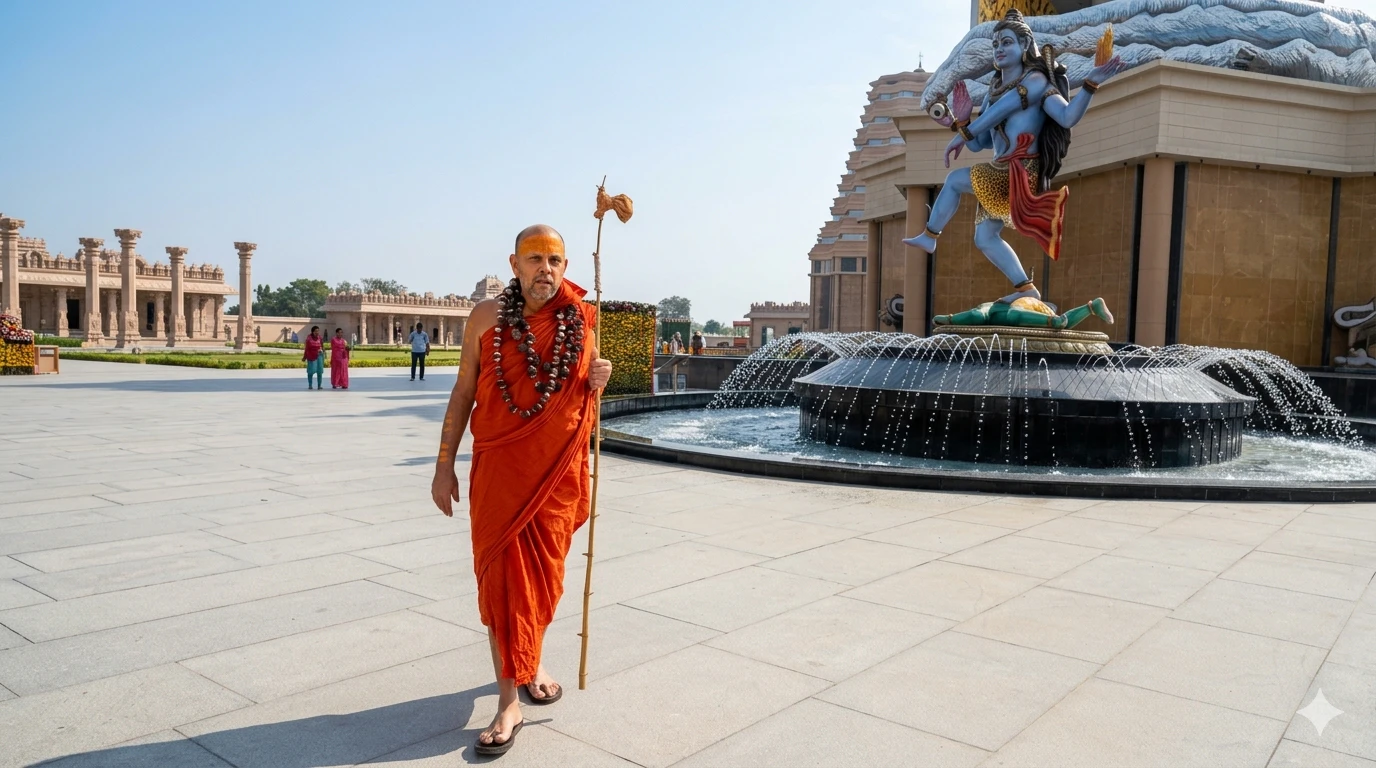
Swami Narayana Theerth represents an unbroken lineage going back 1,200+ years to Adi Shankaracharya, embodying a rare combination of deep scholarship, intense spiritual practice, and selfless service.

Early Life: Mastering the Vedas
Background
Born in Southern Tamil Nadu into a traditional Brahmin family that followed the Krishna Yajurveda (one of the four ancient Vedas) and the Apastamba Sutra (a system of rituals and conduct).
What is Ghanapaatha?
Imagine memorizing an entire book - not just forward, but also backward, and then in complex patterns like (1-2, 2-1, 1-2-3, 3-2-1, 1-2-3). That's Ghanapaatha - the most difficult way to preserve Vedic texts!
Under expert teacher Brahmasri Narayana Ghanapati, young Swamiji achieved mastery in this ancient technique that ensures not a single syllable is lost over thousands of years.
Sabda Brahman - Sound as Divine
Through this intense practice, he realized Sabda Brahman - understanding that sacred sound itself is a path to experiencing the Divine. This became the foundation of his teaching.

Becoming a Monk: The Great Renunciation
Mahashivaratri 1976
On the holy night of Mahashivaratri in 1976, he took Sanyasa (monastic vows) - meaning he gave up all worldly possessions and family ties to dedicate his life completely to spiritual practice and teaching.
His Spiritual Teachers (Gurus)
• Anantasri Swami Niranjana Dev Teerth - Sankaracharya of Govardhana Peeth, Puri, who formally initiated him into the monastic order
• Anantasri Abhinava Vidya Teertha Mahaswamin - Of Sringeri Sharada Peetham, whom Swamiji revered as a "living God on earth"
Guru-Shishya Parampara (Teacher-Student Tradition)
This is the traditional way spiritual knowledge is passed down - not just as book learning, but as lived experience. The teacher shares not just words, but actual realizations from their own spiritual journey.
The Upanishads He Studied
Ancient philosophical texts that explore the ultimate questions of existence:
• Taittiriya - Nature of reality
• Mandukya - States of consciousness
• Chandogya - "You are That"
• Katha - Dialogue with Death

The Epic Walking Journey
400,000 Kilometers Walked
That's more than the distance from Earth to the Moon (384,400 km) - all done on foot!
Why Walk So Far?
• Bringing Wisdom to Remote Villages - Many people in remote mountain villages and rural areas have no access to spiritual teachings. Swamiji walks to their doorstep to share the Vedas and Upanishads.
• Uniting India Spiritually - His travels across all states and even Nepal strengthen the cultural and spiritual bonds that connect the Indian subcontinent.
• Sharing Advaita - For Swamiji, walking itself is meditation. With each step, he experiences and shares the teaching that everything is connected - we are all one at the deepest level.
"Following the footsteps of Loka Guru Shri Adi Sankaracharya" - just as the great teacher Adi Sankara walked across India 1,200 years ago to unite and teach, Swamiji does the same today.

Deep Knowledge: Scholar & Yogi
The Six Systems of Indian Philosophy
• Purva Meemamsa - Study of Vedic rituals and how to interpret sacred texts
• Uttara Meemamsa (Vedanta) - Study of ultimate reality - What is Brahman? Who am I?
• Tarka & Nyaya - Indian logic and reasoning - how to think clearly and debate
• Samkhya, Yoga, Vaisheshika - Other philosophical systems
Yoga & Meditation Mastery
Expert in multiple advanced yogic practices:
• Transcendental Meditation - Deep meditation techniques
• Kriya Yoga - Energy awakening practices
• Ashtanga Yoga - Eight-limbed yoga path
• Raja Yoga - Royal path of meditation
• Vaashi Yoga - A rare and secret practice involving control of Prana (life force/breath) to reach very high states of consciousness. Very few masters know this!

Kalika Peeth, Gangotri
As Shankaracharya (spiritual head) of the Kalika Peeth, Swamiji serves from Gangotri - a sacred place high in the Himalayas where the holy river Ganga originates.
This is one of the holiest locations in India - a place of extreme purity and spiritual power, representing the pristine Himalayan tradition of meditation and austerity.
From this sacred seat, he continues to teach students the Shastras (scriptures), ensuring that the flame of ancient wisdom keeps burning bright for future generations.
Vision for the Future: Eight Spiritual Centers
2027-2028 Expansion Plan
Just as Adi Shankaracharya established 4 Mathas (spiritual centers) across India 1,200 years ago, Swamiji plans to establish 8 Mathas in all directions.
Why? India's population is now over 140 crore (1.4 billion) people! We need more centers for spiritual education, cultural preservation, and ethical guidance.
Goal: Create institutions that provide spiritual education, strengthen national unity, and ensure the continuity of Dharma (righteous living) for all Indians.